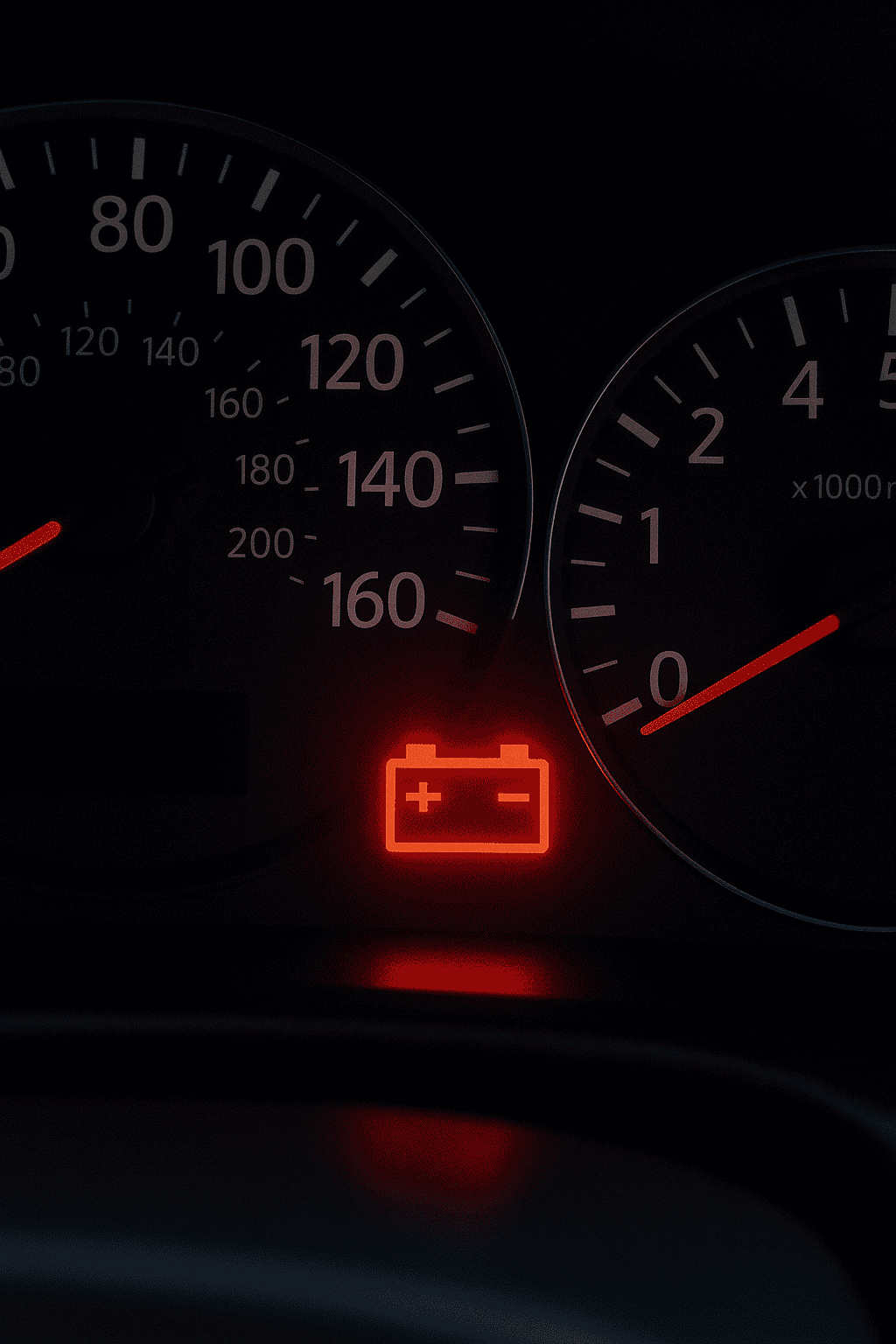
That little red or yellow battery symbol popping up on your dashboard is one of the most critical and yet most misunderstood warnings in your car. Many drivers assume it simply means the battery is weak, but the truth is far more serious: when the battery light turns on while driving, it signifies a catastrophic failure in your vehicle’s charging system.
Here is the crucial distinction: the battery’s job is purely to provide a brief burst of power to start the engine. Once the engine is running, the alternator takes over. The alternator generates the continuous electrical power required to run everything—the ignition system, fuel pump, headlights, wipers, and —while simultaneously recharging the battery. Therefore, if the light is on, it means the alternator is no longer doing its job. Your car is running purely on the finite, stored energy within the battery. This isn’t just an inconvenience; it’s a countdown to a complete, potentially dangerous roadside stall. Our goal is to give you the immediate action steps you need to take to get safely off the road and prevent that breakdown.
Urgent Steps: What to Do Immediately When the Battery Light Turns On While Driving
Seeing that red light flash is scary, but panic is the enemy. The most important thing you can do is recognize that you have a limited window of power. Your primary goal is to minimize electricity usage and get to a safe location or a repair facility before the engine cuts out entirely.
- Safety First: Your first action should always be to pull over to a safe location if you are far from home, or, if you know a trusted repair shop is only a mile or two away, head straight there immediately.
Minimize Electrical Load (The Power-Saving Checklist)
Every electrical accessory you leave running is draining those precious minutes of stored battery life. The less power you use, the farther you can drive. You must perform an aggressive electrical system shutdown immediately.
- Turn off the Air Conditioning (AC) and Heater: These systems use high-powered fans and compressors that are massive energy consumers. Shut them down completely.
- Shut Down Entertainment: Turn off the radio, navigation, infotainment screen, and any seat heaters.
- Unplug All Accessories: Disconnect all phone chargers, USB devices, GPS units, and dashcams.
Drive Minimally and Conserve Energy
Once you’ve reduced the electrical drain, you need to drive as efficiently as possible to maximize your remaining power.
- Head Straight to a Mechanic: Do not run errands or make detours. Every foot of travel costs battery life.
- Avoid High Speeds and Acceleration: Smooth, consistent driving is key. Hard acceleration draws more power from the ignition system.
- Night Driving: If it’s dark, you obviously need your low beams, but avoid using high beams or fog lights unless absolutely necessary.
- Understand Your Time Limit: Based on the battery’s health and how many accessories you’ve managed to turn off, you typically have between 15 to 45 minutes of driving time left before the engine will sputter and die. Treat the light as a literal countdown timer.
Why Is My Battery Light On? Top 3 Causes of Charging System Failure
The battery warning light is triggered by the vehicle’s computer (ECM) when it detects that the system voltage has dropped below a critical threshold (typically around 13.0 volts). This tells the computer that the alternator isn’t producing the required power. While the simple answer is “the alternator is bad,” the root cause often lies in one of three areas:
1. The Failed Alternator (The Most Common Cause)
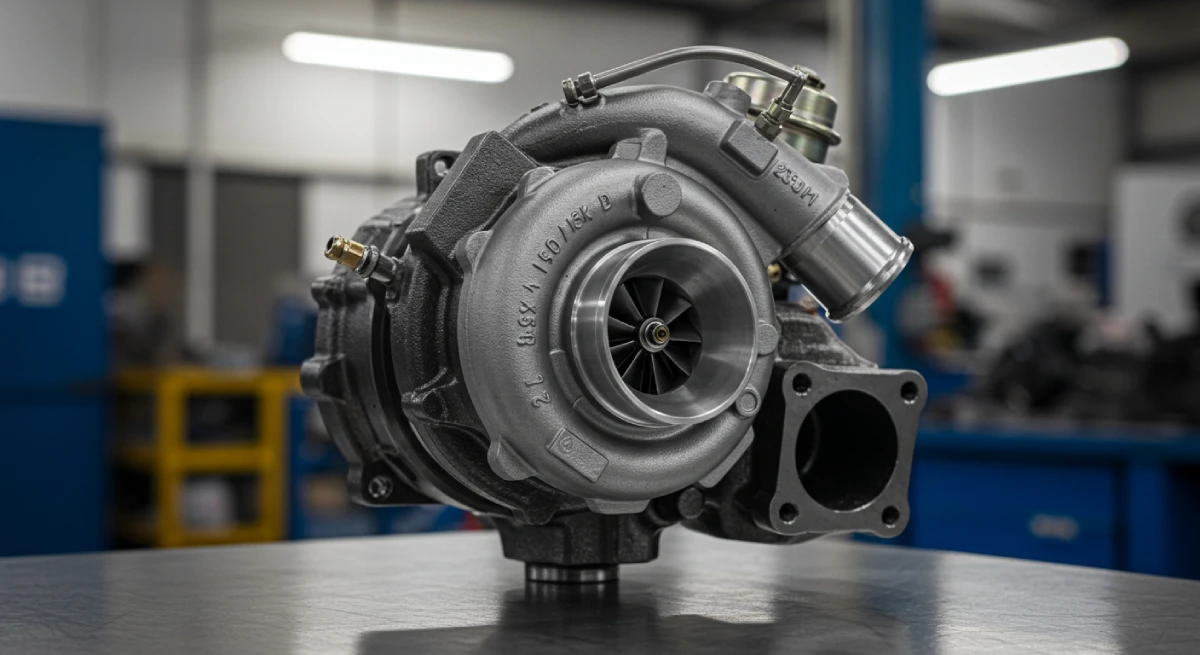
The alternator is a mini generator driven by the engine. Its job is complex, involving two main processes: generating alternating current (AC) and converting it to the stable direct current (DC) needed to run the car. When the alternator fails, it’s typically one of its internal components giving out due to heat, friction, or age.
- Diode Rectifier Failure: The rectifier is responsible for converting the raw AC power into usable DC power. If one or more diodes fail, the alternator starts leaking AC current into the system, which can damage the car’s sensitive electronics and cause unstable voltage.
- Voltage Regulator Failure: This component ensures the alternator puts out a consistent voltage (around 13.5 to 14.5 volts). If it fails, the alternator may either overcharge the battery (causing overheating and damage) or, more often, undercharge the battery, immediately triggering the dashboard warning light.
- Worn Brushes or Slip Rings: These parts wear down over time, leading to poor electrical contact, which reduces the alternator’s output until it can no longer keep up with the vehicle’s demands.
2. A Loose or Broken Serpentine Belt
The alternator is a passive component; it requires the engine to physically spin it via the serpentine belt (sometimes called the drive belt). If this belt is compromised, the alternator simply can’t do its job.
- Belt Slippage: If the belt is old, cracked, or if the tensioner that holds it tight fails, the belt will slip on the alternator pulley. This slippage prevents the alternator from spinning fast enough, leading to insufficient power generation and, subsequently, the battery light turning on. This is often accompanied by a distinct screeching or squealing sound, especially during acceleration or when turning on accessories.
- Belt Failure (Snapping): The worst-case scenario is when the serpentine belt snaps entirely. This is an immediate emergency. Not only does the alternator stop, but the belt typically runs other crucial systems, including the power steering pump (making steering incredibly difficult) and, critically, the water pump (which will cause the engine to overheat rapidly). If the belt snaps, you must pull over immediately to prevent severe engine damage from overheating.
3. Corroded or Damaged Battery Cables
Sometimes, the alternator is working perfectly fine, but the power it generates can’t get where it needs to go due to a connection issue.
- Terminal Corrosion: Battery terminals often accumulate a white or blue-green powdery substance called sulfation or corrosion. This corrosion acts as a heavy electrical insulator, dramatically increasing the resistance in the circuit. The alternator may be pumping out 14 volts, but if the resistance is too high, the vehicle’s electrical system receives far less (say, 12 volts or less), which activates the warning light.
- Loose Connections: A terminal clamp that has vibrated loose, or a ground cable that has become disconnected from the chassis, will prevent the system from completing its circuit. This mimics a complete charging system failure, as the alternator’s power has no path to the battery or the vehicle’s electrical components.
Getting It Fixed: Estimated Repair Costs and Lifespan
Once you’ve safely reached EBA Automotive, our certified technicians will perform a comprehensive diagnostic check of your entire charging system. Never guess the cause of a battery light, as a misdiagnosis can lead to expensive, unnecessary repairs. Modern systems require specialized tools to pinpoint whether the problem is the belt, the battery, the alternator, or the wiring.
- Diagnostic Check: The diagnostic process typically involves a multi-point voltage test under load, ensuring we isolate the exact failing component before suggesting any repairs.
Alternator Replacement Cost and Lifespan
Alternator replacement is often the most expensive charging system repair, largely due to the high cost of quality replacement parts and the labor involved.
- Cost Range: The total cost for parts and labor typically falls between $500 and $1,200, but can easily exceed $2,000 for luxury vehicles or trucks where the alternator is difficult to access (e.g., buried under the intake manifold).
- Cost Factors: The final price depends on the make and model of your vehicle, the difference between cheaper aftermarket parts and more durable original equipment manufacturer (OEM) components, and the labor time required for removal and installation.
- Lifespan Expectation: A new or high-quality remanufactured alternator should last between 80,000 to 150,000 miles. Investing in a good-quality part is highly recommended to avoid repeat failure.
Serpentine Belt and Tensioner Repair
Repairing the belt system is generally much less costly than replacing the alternator, though it’s equally critical to the car’s function.
- Belt Replacement: A new serpentine belt itself is relatively inexpensive, but labor is required to correctly route and tension the new belt. Total cost typically runs from $100 to $300.
- Tensioner/Pulley Replacement: If the problem is the tensioner pulley (which keeps the belt tight) or an idler pulley, the cost will increase slightly, but it still remains far less than an alternator replacement.
Simple Battery and Cable Repairs
In the best-case scenario, the fix is quick and inexpensive, preventing you from needing an entirely new alternator.
- Terminal Cleaning and Tightening: Removing and cleaning corrosion, and securely tightening the battery terminals, is often the cheapest fix, typically costing under $100 and sometimes covered as part of a routine service.
- Cable Replacement: If the cables are internally corroded, frayed, or damaged, they must be replaced. This involves more labor but is still usually less than $400 total, which is significantly cheaper than a new alternator.
Prevention: How to Keep Your Charging System Healthy
- Routine Visual Inspection: Check the serpentine belt condition (look for cracks, fraying) and battery terminals (look for white/blue corrosion).
- Don’t Ignore Early Signs: If you notice dimming lights, slow cranking, or hear grinding/screeching, get the car checked before the battery light comes on.
- Test Battery Health: Get your battery tested regularly, especially if it’s over three years old, to ensure it’s holding a charge efficiently.
Conclusion: Don’t Risk a Roadside Breakdown
- Summary: The battery light is not a suggestion—it’s a countdown. Ignoring it guarantees you’ll be stranded.
- Final Tip: Never attempt to jump-start a car when the battery light is on and the engine is still running, as it points to a charging system failure, not just a dead battery.
Is your battery light on while driving? Don’t leave your safety to chance. Schedule a free charging system inspection with the certified technicians at EBA Automotive right now. We’ll diagnose the issue (alternator, belt, or battery) and get your power flowing reliably again!